What is a class?
A class is a set of objects that have the same properties and behaviors. For example, what students majoring in software have in common is that they hear majoring in software as a fact and same majoring class as a fact. In this case, student majoring in software can be said to be a class of actual students.
Another way to define a class is to see it as a blueprint for creating an instance (object). The source code below defines a student class majoring in software. Let’s take a look at the code from the perspective of a blueprint for how classes create objects.
public class Student{
    private String name;
    private String major = "SW";

    public Student(String name){
        this.name = name;
    }

    public void study() {
        System.out.println("Taking an object-oriented modeling class.");
    }
}
Student student1 = new Student("student1");
Student student2 = new Student("student2");

student1.study();
student2.study();
Through the above code, two student objects with the same specifications were created. Both objects have the same characteristics except for their names. The major attribute is the same as SW, and the same sentence is output when the study() method is executed. This is why classes are the blueprint for creating objects.
The same object is always created in the same blueprint.
UML Modeling
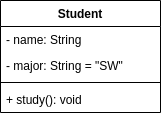
The result of notating the Student class using UML is as above. From the top, ClassName, Property, and Operation are described for each section. If there are no properties or operations, they can be omitted.
access controller
| access controller | mark | explanation |
|---|---|---|
| public | + | Accessible to objects of any class |
| private | - | Only objects created in this class can be accessed. |
| protected | # | Only objects of subclasses that are in the same package as this class or have an inheritance relationship can be accessed. |
| package | ~ | Only objects of classes in the same package can be accessed. |
When defining class properties and operations, symbols such as - or + are used, which are access modifiers that define visualization. You can think of private and public in Java as written as above.
Properties and Operations
| division | notation |
|---|---|
| attribute | [Access Controller]Name: Type[Multiplicity Information] [=Initial Value] |
| calculation | [Access Controller] Name (Argument: Type): Return Type |
The format for notating properties and operations is as above. Class diagrams are widely used from the concept analysis stage to implementation, but in analysis stage, the main purpose is to define properties or operations rather than express them in detail. Afterwards, specific type information or visualization information is described in design phase.
It means that anything contained in
[]can be omitted.
relationship
In object-oriented programming, you rarely use just one object. Usually, objects are divided by function, and their interaction makes one software run. The relationship between these classes is expressed in UML as follows.
association
It means that the classes are conceptually connected and is indicated by a solid line.

two-way association
A case of recognizing each other, such as the relationship between a professor and a student class, is called a two-way relationship and is indicated by a no arrow solid line.
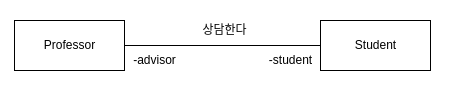
If you want to indicate that they are consulting, you can specify it in the solid line top as shown above. rule name in the association relationship can also be determined by defining both ends in the solid line. This can be used as property to refer to each other in the later stages of program implementation.
one-way association
One student can take multiple classes. If this is modeled through UML, it can be expressed as follows.
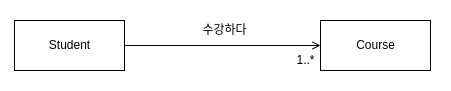
At this time, the arrow is pointing from the student to the class, which means it is student recognizes the class, and conversely, the class does not recognize the student. This case is called one-way association.
In the diagram above, there is a notation called 1..*, which represents multiplicity. Multiplicity means number of related objects.
*means0 or more, and..represents the range. Therefore,1..*means1 or more. If there is only one object, it may be omitted.
Many-to-many associations
If you think about the previous example carefully, you may realize that something is strange. In the real world, there is never a case where only one student takes a class. Usually, multiple students take multiple classes. If you express this, the picture below will appear.
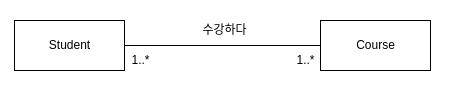
The relationship that many objects - many objects has is called many-to-many association relationship, and this is generally expressed as two-way association relationship in UML.
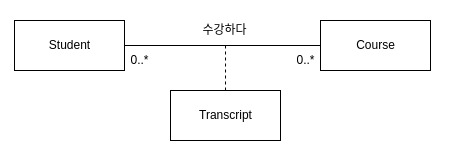
However, if a student wants to save grade information generated while taking a class, where should it be stored? If you store grade information as is in a student or class, it will be expressed as follows.
‘Student Hong Gil-dong is an A+’ or ‘He received an A+ in the object-oriented modeling class’
However, it is missing information about who earned the grade in which class. Therefore, it is correct to create separate class and save student grades rather than saving them to the student or class. The same class as Transcript used at this time is called Associated class.

The actual implementation of associative class is achieved by converting generic class to one-way association.
When actually implementing a program,
two-way associationis not used!
recursive association
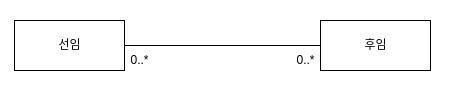
Associations are sometimes recursive. For example, in the military, there is a relationship called senior and successor. A soldier who is a senior to me is a junior to someone, and a soldier who is a junior to me is also a senior to someone.
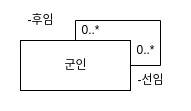
In this case, a contradiction arises where the class called soldier belongs to two classes, namely senior and junior, at the same time. However, creating the two classes separately lacks flexibility. In these cases, recursive association is used.
However, the problem of relationship loop remains in recursive associations. For example, rock, paper, scissors is a game where scissors beats paper, paper beats rock, and rock beats scissors. If a loop exists like this, it must be excluded by setting a constraint to {hierarchy}.
{Hierarchy}means thathierarchyexists between objects andcycledoes not exist.
generalization relationship
It is a relationship between two classes when one class contains another class super concept.

Child class (subclass) can inherit properties or operations from parent class (superclass). That is why the generalization relationship is also called inheritance relationship.
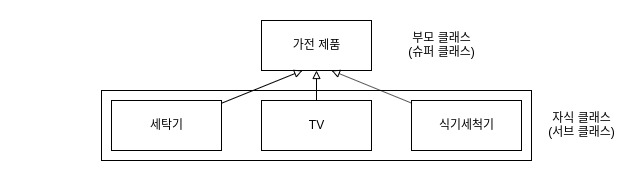
Usually, a generalization relationship is called a is-a-kind-of relationship. The relationship between home appliances and washing machines can be described as washing machine is-a-kind-of home appliance.
set relationship
A set relationship is a special case of an association relationship and is used when you want to clearly specify the relationship between the whole and the parts. There are two types of set relationships: aggregation and composition.
intensive relationship
Indicates that one object contains another object.

- Empty diamond in class direction pointing to whole
- Can
share with other objectspartial objects Lifetimeof whole object and partial object are independent
composite relationship
It is a relationship in which a partial object belongs to the whole object.

- A filled diamond in the class direction pointing to the whole.
- Cannot
share with other objectspartial object Lifetimeof a partial object depends on the whole object
difference
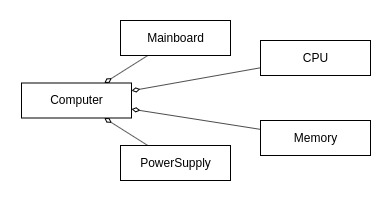
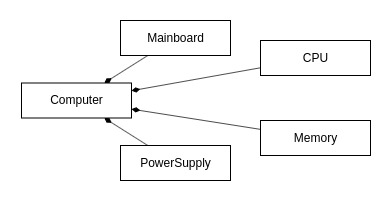
Aggregation relationships and composition relationships may seem similar at first glance, but they have a big difference. The most important difference is Lifetime. When the entire object is destroyed if the partial object remains it is aggregate relation. In the opposite case, you can think of it as composite relationship.
Let’s find out the difference between the two using the example of assembling a computer.
public class Computer {
    private MainBoard mainBoard;
    private CPU cpu;
    private Memory memory;
    private PowerSupply powerSupply;

    public Computer(MainBoard mainBoard, CPU cpu, Memory memory, PowerSupply powerSupply){
        this.mainBoard = mainBoard;
        this.cpu = cpu;
        this.memory = memory;
        this.powerSupply = powerSupply;
    }
}
Computer objects are created by receiving an externally created motherboard, CPU, memory, and power supply. Therefore, even if a computer object is destroyed, the partial objects that make up the computer do not disappear but remain in memory. Therefore, we can see that the above source code represents aggregate relationship.
public class Computer {
    private MainBoard mainBoard;
    private CPU cpu;
    private Memory memory;
    private PowerSupply powerSupply;

    public Computer(){
        this.mainBoard = new MainBoard();
        this.cpu = new CPU();
        this.memory = new Memory();
        this.powerSupply = new PowerSupply();
    }
}
Unlike the previous example, the code above creates the computer and its components are created at the same time. Therefore, the life cycle of the elements depends on the entire object. It can be viewed as composite relationship because partial objects disappear at the same time as the computer is destroyed.
dependency
This is a relationship that appears when using functions provided by other classes.

In general, there are three cases where one class uses another class:
- Reference from property of class
- Used as an argument for operations
- Reference to local object inside method

The diagram above shows that a person owns a car and recharges the car at a gas station. At this time, the relationship between person-car is associative relationship, but the relationship between car-gas station is dependency relationship.
public class Person {
    private Car car;

    public void setCar(Car car){
        this.car = car;
    }
    ...
}

public class Car {
    public void fillGas(GasPump p){
        p.getGas(amount);
        ...
    }
}
Since the car people ride does not change every time, the Car object is referred to as an attribute of the Person class. On the other hand, the main element of refueling the car is not the same every time, so it is implemented through argument or local object.
materialization relationship
It is the relationship between an interface and the class that instantiates its responsibilitiess.
Responsibility refers to
what an object must dotowhat it can do.

The interface itself is not an object that actually carries out responsibilities. An object created through instantiation performs the responsibilities defined in the interface.
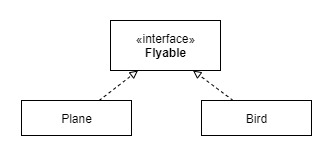
For example, classes Plane and Bird that instantiate an interface called Flyable, which contains the responsibility for flying, must implement the responsibilities of that interface. In this respect, an interface can be viewed as representing things that have certain common capabilities. That is why the materialization relationship is called the can-do-this relationship.