Abstraction
It is a means of understanding the common characteristics of concrete objects and treating them as a concept. In other words, it is about extracting key concepts or functions from complex data, modules, systems, etc.
These abstractions are essential for creating classes in Object-Oriented Programming (OOP). If there is no abstraction, every object must be defined and implemented in detail.
Encapsulation
Encapsulation is an object-oriented design principle that allows high cohesion and low cohesion through information hiding.
Cohesion and binding
The design of a class should be reusable, extensible, and maintainable. For this to happen, cohesion must be low and cohesion must be high.
- Cohesion
- The degree to which elements within a class or module are closely related
- Coupling
- Degree to which a function depends on other classes or modules to perform it
information hiding
Information that does not need to be known is restricted from being accessed from the outside. We can drive a car without knowing how it works, and we can use a computer well without knowing how it works.
public class ArrayStack {
    public int top;
    public int[] itemArray;
    public int stackSize;

    public ArrayStack(int stackSize) {
        itemArray = new int[stackSize];
        top = -1;
        this.stackSize = stackSize;
    }

    public void push(int item) { // add item
        ...
    }

    public int pop() { // return item
        ...
    }

    public int peak() { // print item
        ...
    }
    ...
}
ArrayStack is a stack implemented using an array. You can add items using the push function and return them through pop.
public class StackClient {
    public static void main(String[] args){
        ArrayStack st = new ArrayStack(10);
        st.itemArray[++st.top] = 20;
        System.out.print(st.itemArray[st.top]);
    }
}
However, ArrayStack’s properties are all designated as public, so they can be accessed from the outside. In this case, you can directly handle the array without using the push function, and a strong coupling occurs between StackClient and ArrayStack.
If the implementation of the stack changes, the source code of StackClient may also need to be changed. Therefore, you should avoid directly handling stack properties. Therefore, the properties of ArrayStack are prevented from being accessed by external classes by setting the access modifier to private. Now that you can no longer manipulate the array directly, StackClient must be modified as follows.
public class StackClient {
    public static void main(String[] args){
        ArrayStack st = new ArrayStack(10);
        st.push(20);
        System.out.print(st.peek());
    }
}
Generalization
It is a process of highlighting the common characteristics of various entities and establishing them as a single concept or law.
- The generalization relationship is called an inheritance relationship from an object-oriented programming perspective.
- Therefore, it is often used to emphasize only the reuse of properties or functions.
- This is an extremely limited view of the generalization relationship.
Generalization for encapsulation
Generalization can also be seen as the concept of encapsulation (or hiding) a child class to the outside world.
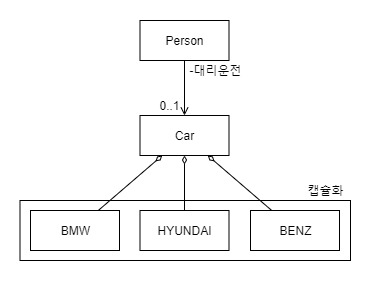
For example, when we classify cars, we classify them into various manufacturers such as BMW, Hyundai, and Benz. Assuming a situation where a designated driver is driving, the vehicle type does not have a significant effect on driving. From the perspective of the person class, you only need to be interested in the car class, not the specific car. Therefore, the specific car class can be seen as concealed.
Generalization from a set theory perspective
The generalization relationship can also be interpreted from a ‘set theory’ perspective.
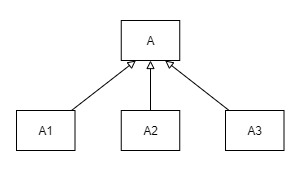 The parent class A corresponds to the entire set A, and its subsets A1, A2, and A3 respectively correspond to child classes of A. At this time, the following relationship must be established:
A = A1 ∪ A2 ∪ A3A1 ∩ A2 ∩ A3 = ø
And the following constraints also exist.
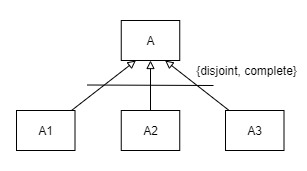
{disjoint}: A child class object cannot belong to two classes at the same time.{complate}: There is only oneobject of the child classcorresponding to the object of the child class andobject of the parent classcorresponding to the object of the parent class.
By creating a generalization relationship from a set theory perspective, the association relationship can be simplified.
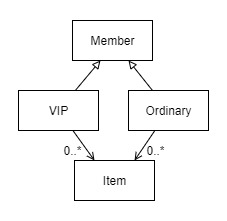
If an online shopping mall is classifying VIP customer and regular customer, you can draw a diagram like the one above. Each member can have an association with each item, but purchasing the item has nothing to do with the level.
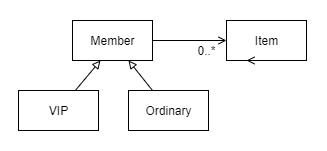
In other words, the association relationship with the object class is common association relationship of the child class of the object class. Therefore, we can simplify the diagram by associating object classes with member classes.
Generalization from a set theoretic perspective can be viewed as a process of dividing something into mutually exclusive subsets.
What should we do if criteria for classifying members are added? Web shopping malls sometimes provide services not only to domestic members but also to foreign members. When providing different services depending on the member’s country, this distinction will be necessary.
In UML, this distinction is called discriminator and discriminator information is displayed next to the line indicating the generalization relationship. However, in this case, members are classified according to nine criteria (payment amount, region), and one instance that can belong to multiple classes at the same time is called multiple classification. Expressed using the <<multiple>> stereotype.
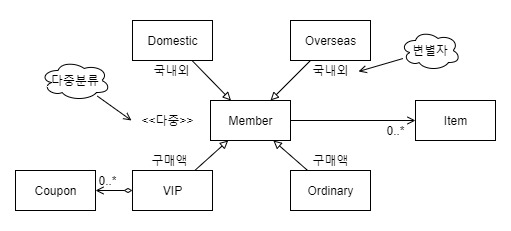
In general, if the generalization relationship for each discriminator is completely independent, there is no problem. However, due to changes/additions in requirements, both situations where the generalization relationship is not independent must also be considered.
For example, in the diagram above, it is easy to implement providing a discount coupon to VIP members, but providing a gift to regular level foreign members is impossible.
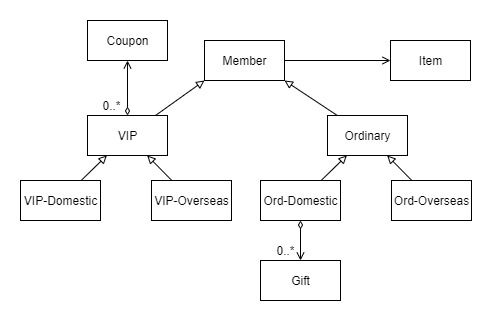
One way to handle this is to create classes corresponding to all classifiable combinations.
Polymorphism
This is the ability for objects of different classes to act in their own way when they receive the same message.
Let’s consider the car example we saw earlier in [Generalization for encapsulation](#Generalization for encapsulation). It is possible to drive a car regardless of its brand. So, from the perspective of the people class, you only need to be interested in the car class. The reason this is possible is because there is polymorphism.
abstract class Car {
    public abstract void ride();
}

public class BMW extends Car {
    public void ride() { ... }
}

public class HYUNDAI extends Car {
    public void ride() { ... }
}

public class BENZ extends Car {
    public void ride() { ... }
}

public class Main {
    public static void rideCars(Car[] cars) {
        for(Car car: cars){
            car.ride();
        }
    }

    public static void main(String[] args){
        Car[] cars = {new BMW(), new HYUNDAI(), new BENZ()};
        rideCars(cars);
    }
}
When you use polymorphism, you can program independently of which class object is currently being referenced. Therefore, even if a new car class is added as a child class, the code will not be affected.
The reason this is possible is because the reference variable of the parent class can be reference an object of the child class when in a generalization relationship. However, only the parent class inherited variables and methods can be accessed by the reference variable of the parent class.
Peter Codd’s Inheritance Rules
Peter Code created rules that strictly limit the use of inheritance to prevent its misuse.
- There must not be a
role performancerelationship between the child class and the parent class. - An instance of one class should never need to be converted to an object of another subclass.
- The child class must only perform
extendswithout overriding or redefining the parent class’s responsibilities. - Child classes should not inherit
classes that perform a utility rolejust to reuse some functionality. - The child class must specialize
role,transaction,device, etc.